Free Telehealth Nursing System
Sample Training, Standards, Guidelines, Documentation, Process, Audit, Sample Conference
DOWNLOAD FREE RESOURCES
Quality = Well Designed Structure, Process and Outcomes (Donabedian, 1992)
TELEHEALTH NURSING SYSTEM SAMPLES
NEW! Telehealth Clinical Conference Sample Programs (1996- 2001). The first remote triage nurse conference founded by Sheila Wheeler and Contemporary Forums. Updating this program would require EBM Research-based Update and Review of High Risk Populations (Women, Children, Elderly, Disabled), Cognitive Skills (pattern recognition, patient contextual review, heuristics, and clinical decisionmaking), Legal issues, Case study role plays,
COMPONENT ONE: Guidelines 45+ guidelines address emergent to non-urgent symptom patterns for Adult, School Age & Infant-Child
COMPONENT TWO: Documentation Form Based on the Nursing Process: assessment, documentation, communications,risk management
COMPONENT THREE: Telehealth Nurse Clinical Training Materials (Five Courses) include:
Preceptor Syllabus: Introductory Training program. How To and Risk Management for Telehealth Nursing
How to Perform nurse triage including Risk Management for Telehealth Nursing
Job Standards: job qualifications, job description and practice standards.
UNIQUE 30-page Guideline Users Guide – Guidelines contain innovative Users Guide — unique and complete with insightful FAQs.
UNIQUE Audiolinks to 20 real life malpractice remote nurs triage case studies with tutorials for discussion & analysis
COMPONENT FOUR: AAACN Telehealth Nursing Standards –
COMPONENT FIVE: TELEHEALTH NURSE QUALIFICATIONS
COMPONENT FIVE: TELEHEALTH NURSE QA AUDIT QUALIFICATIONS
Telehealth Nursing & Remote Nurse Triage System
Layers of Protection: Essential System Resources
(Training, Guidelines, Documentation, Standards, QA Audit)
Free resources can be downloaded. No registration or email address required. This nurse -driven virtual triage system represents a complete framework for a complete system —based on foundational and recent research. The components serve as “layers of protection” (Robert Smith, JD) — evidence of employers’ and nurses’ efforts to fullfill the clinical “duty of due care” to reduce patient harm and malpractice risk. Components are informed by concepts (Structure-Process-Outcomes) formalized by Donabedian, MD, (1992), and relevant nursing and medical specialties.
Telephone Triage Workflow Process (2015-2025) Nurse triage requires estimating, then classifying symptom urgency. Nurse Triage Process Workflow is a Framework that broadly but succinctly outlines the Triage Task — Process, Structure and Outcome with 5-level triage. Deceivingly simple in appearance, it represents how the basic nursing process (assessment, working diagnosis, plan, evaluation) can be adapted to remote triage.
PLEASE NOTE: In the US, current HIPAA privacy policy is inadvertently impeding the fourth step of the nursing process — evaluation of patient outcomes, i.e., was the remote nurse triage decision safe? Learning about patients’ diagnosis after an on-site evaluation. This step is not represented on the Workflow Process form. Revising this policy for remote triage enables clinicians to learn from decisions —successful or unsuccessful — helping to improve clinical practice. Of all nursing subspecialties, remote triage requires outcome feedback. Remote triage should not take place in a vacuum defined as “breakdowns in processes, communication, technology, or resources leading to preventable patient harm”. (PDF-2.3 MB)
Telephone Triage Universal Guideline (2025-2026) Remote Triage Template based on Nurse Triage Process Workflow key safety features (PDF-201KB)X. Why TeleTriage Systems Design?
Telephone Triage QA AUDIT(2025-2026) Remote nurse triage performance improvement review. Quality Assurance of Triage Process (PDF-147 KB)
Telephone Triage Documentation Form(1993-2026) A foundational documentation tool faithfully represents the nursing process –modified for triage. The missing fourth step–evaluation or patient outcome will require modified HIPAA regulations. EMR/EHR’s prospective role in synthesizing patient context —risk level — based on Predictive Analytics of past & current medical history (PDF-692 KB)
Telephone Triage Job -Qualifications, -Description & -Competencies (2025-2026)(PDF-781 KB
Telephone Triage Rules of Thumb (Heuristics) (2025-2026) Nurses use Rules of Thumb to perform triage (Lephrohon, Patel 1995) (PDF-182 KB)
Care for Caregiver (1993-2025): Stress Reduction, Job Satisfaction for High Stress Task (2025) (PDF-66 KB)
Telephone Triage-Specific Phone Tree (2000-2025) Avoid “Triage Volume Overload” (PDF-35 KB)
Patient Brochure for Telephone Triage Services (1993- 2025) UNIQUE Tool “How to Help the Triage Nurse Help You” (PDF-72 KB)
Telehealth Nursing/Telephone Triage Training
Essentials for Telephone Triage (2025) Updated Nurse Triage “How To” Course (PDF-505 KB)
Telephone Triage Risk Management 3 (2020-2026) Research, Standards, Case studies (PDF-722 KB)
Telephone Triage Guideline Competency (2017) First User’s Guide for Nurse Triage Guidelines (PDF-6.6 MB)
Telephone TriageRisk Management 1 (2005) Triage trends, risks, controversies & case studies. (PDF-1 MB)
Telephone Triage Risk Management 2(2006) Experts discuss nurse triage risks & solutions. (PDF-800 KB)
Slide decks collectively address current risk management issues, system error, common practice error, malpractice and near misses.
Telephone Triage: Creating a Culture of Safety (2020) Risk Management (PDF-372 KB)
Telephone Triage Protocols for High Risk Populations (2019) Protocol Design, Bhopal India (PDF-241 KB)
To Err is Human, To Delay is Deadly (2012 - 2025) Risk Management. case studies (PDF-372 KB)
Telephone Triage Essentials for Expert Practice (2016 - 2025) Updated Power Point Slides for the How To” Clinical Training (PDF-590 KB)
Remote Nurse Triage & Telehealth Nursing Case Studies & Tutorials (Audio-links)
10 + Case Studies (1993) (Thomson-Delmar), Audio-links to Adult & Pediatric Remote Nurse Triage Malpractice Cases (MP3-11.8 MB)
10 + Case Studies (2009) (McGraw Hill) Audio-links to Adult & Pediatric Remote Nurse Triage Malpractice Cases (MP3-6.3 MB
Telephone Triage Foundational Guidelines
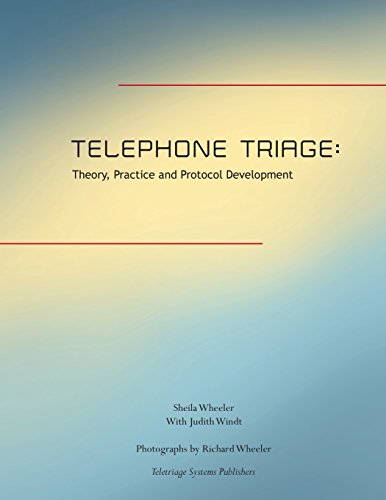
First Training Manual Telephone Triage: Theory, Practice & Protocol (1993) Classic “How to” for Telephone Triage. (PDF-62.5 MB)
Table of Contents for Telephone Triage: Theory, Practice and Protocol Development(PDF-470 KB)
Telephone Triage:Adult & Womens’ Health(2017) (PDF-215.8 MB)
Telephone Triage of School Age Children Age Six to 18 Years (2017) (PDF-62.7 MB)
Telephone Triage of Infants & Children Age Birth to Six Years(2005) (PDF-36 MB)
First National Telephone Triage Conference (1994-2001) (PDF-6.54 MB). This historic conference addressed basic, broad telehealth fundamentals: protocols, quality assurance, populations, cultural sensitivity, emerging specialties, and operational management. Key topics include communication and documentation issues, case studies, legal and medical-legal considerations, protocol development, and staff competencies. Sessions addressed specialty areas: women’s health, pediatrics, the elderly emergencies, and mental health, emphasizing best practices, interprofessional communication, and system implementation.
Telephone Triage Research (1989 -2023)
Safety of Clinical and Non-Clinical Decision Makers in Telephone Triage. (2015) Wheeler, SQ., et al. Compares clinicians” & non-clinicians’ triage practice and safety.Journal of Telemedicine and Telecare:(PDF-186 KB)
Lessons Learned from Unusual Calls to the ED (1989). Wheeler, SQ. Journal of Emergency Nursing. (PDF-160 KB)
Google Scholar Articles (10). Sheila Quilter Wheeler research dating from 1993-2023
Telephone Triage Articles & Research (2000-2020) Archival Nurse Triage topics by Wheeler. (PDF-28.2 MB)
WayBack Machine: Internet Archive Explore TeleTriage Systems Historical Website dating from 19-2026
TeleTriage Systems Copyright Statement. Copyright 1993 -2026 Sheila Quilter Wheeler, TeleTriage Systems Publishers. All Rights Reserved. All materials are protected by copyright. No part of it may be reproduced, stored in a retrieval system, or transmitted, in any form, or by any means – electronic, mechanical, photocopy, recording or otherwise – without prior written permission of Sheila Wheeler, except for brief quotations embodied in critical articles and reviews. DOWNLOAD FREE TELEPHONE TRIAGE RESOURCES
For problems receiving free materials, for permissions, contact Ms. Wheeler @ 415 453 8382
Telehealth Nurse Guidelines
UNIQUE FEATURES: All Age-Based, 5-Level Triage
Adapts and describes symptom acuity categories American College of Emergency Physicians
Adapts Manchester Triage Group 5-level triage criteria to apply to remote triage encounters
A unique Universal Guideline design approach to pattern recognition and patient context for remote triage
A Universal Guideline that can support clinical triage in several ways:
1. As a consistent structure or Template for designing a full set of guidelines
2 As a contingency or “fall back” guide for cases where no specific guideline applies
3. As a preemptive guideline, or “go to” guide before selecting a more specific guideline
4. As a training tool for newly hired nurses (as an introduction to a new remote nurse triage system, a review of practice and commonly presented symptoms (IOM, Joint Commission, 2011)
A Universal Guideline serves both as an “Uber Triage Check List” as well as a Guideline Template for 45 Key Site-Based Chief Complaints. The unique remote triage design is transparent, explainable and consistent. The clinical approach supports pattern recognition, patient context and heuristics that nurses typically use for the purpose clinical decisionmaking (Lephrohon, Patel, 1995),
The nursing process informs the design of Guidelines, Documentation and Structure. Clinical training increases opportunities to make safer decisions by adapting the nursing process to remote nurse triage to consider:
broad patterns of emergent to non-acute symptoms
broad categories of high-risk patients or patient context
built-in safety prompts, heuristics and standards intended to reduce recurrent error